Estrogen Blocker Side Effects in Men: AI, SERM and OTC Compared
Three Different Drugs Hide Behind One Name
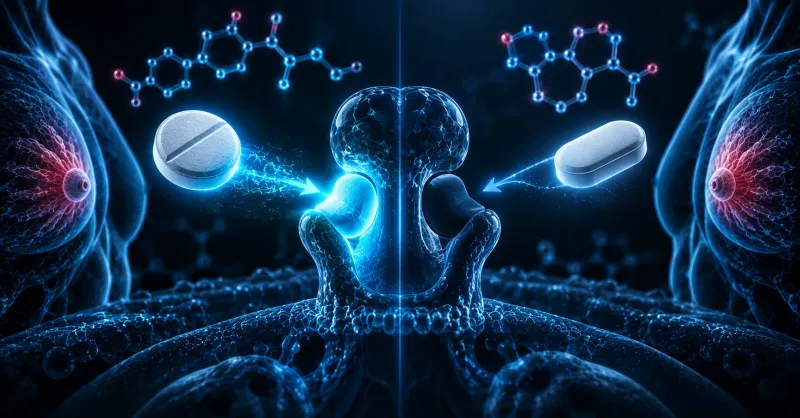
"Estrogen blocker" is a marketing phrase, not a drug class, and the estrogen blocker side effects a man experiences depend entirely on which of three very different things he is taking. Aromatase inhibitors, anastrozole, exemestane, letrozole, stop estradiol being made. Selective estrogen receptor modulators, tamoxifen, raloxifene, clomiphene, leave estradiol alone but block or modify its receptor in specific tissues. Over-the-counter "estrogen blockers", DIM, chrysin, arimistane blends, resveratrol formulas, do neither to any measurable degree and have a side-effect profile to match.
Because the mechanisms differ, so do the problems. An aromatase inhibitor's side effects are almost all the consequences of too little estradiol: dry joints, dead libido, flat mood, worse lipids, and over time weaker bone. A SERM's side effects are the consequences of a drug that is an antagonist in one tissue and an agonist in another: clot risk, hot flushes, visual and mood effects, and a drop in IGF-1. An OTC product's side effects are mostly digestive and cosmetic, because it is not doing much.
This guide walks through each class, explains which symptoms belong to which, and, most usefully, shows how to tell an estrogen crash from the high-estrogen symptoms it is often mistaken for. For a deeper look at the clinical frequencies of AI effects specifically, the aromatase inhibitors side effects guide has the trial data; this article covers the whole category.
Almost every serious estrogen blocker side effect in men is either too little estradiol (aromatase inhibitors) or a receptor effect in the wrong tissue (SERMs). Match the symptom to the mechanism and the fix is usually obvious.
Aromatase Inhibitor Side Effects: the Estrogen Crash
The defining aromatase inhibitor side effect in men is over-suppression. Estradiol does real work in the male body, it maintains bone density, lubricates joints, supports libido and erectile function, regulates fat storage and has a measurable effect on mood and sleep, and when an AI drives it below roughly 15 to 20 pg/mL on a sensitive assay, those functions fail in a recognisable pattern.
The pattern starts within days of an excessive dose. Joints, particularly the knuckles, wrists, knees and shoulders, feel dry and ache; lifters notice it first because it hurts to grip. Libido drops sharply, often to nothing, and erections weaken or disappear. Mood goes flat rather than sad, a lack of drive and enjoyment, with irritability, anxiety and broken sleep. Fatigue is common. Some men get hot flushes and night sweats, the same symptoms postmenopausal women report on these drugs.
The longer-term effects are quieter and more serious. Aromatase inhibitors lower HDL and raise LDL, an effect that compounds any lipid damage from the testosterone or oral steroids they are taken alongside. Bone density falls: in men given anastrozole for a year in clinical studies, spine density dropped measurably, and the breast cancer trials in women show fracture rates roughly 40 to 50% higher on an AI than on tamoxifen. A man who runs low estradiol for years on TRT is exposing his skeleton to a risk the testosterone does not offset.
Estrogen crash symptoms by timeline
Days 2 to 7
Joint dryness and ache, drop in libido, weaker erections
Week 1 to 3
Flat mood, irritability, insomnia, fatigue, hot flushes
Month 1 to 3
Lipid changes on blood work (HDL down, LDL up)
Year 1+
Reduced bone density, cumulative cardiovascular risk
The crash is entirely dose-dependent and entirely reversible in the short term. Stopping the AI lets estradiol recover within one to two weeks for exemestane and two to three weeks for anastrozole, whose half-life is roughly twice as long. The Aromasin half-life guide explains why exemestane clears faster and how that affects dosing.
SERM Side Effects: Clots, Vision, Mood and IGF-1
SERMs do not lower estradiol, so they do not cause the crash. Their side effects come from partial agonism, acting like a weak estrogen in some tissues, and from a class-wide effect on clotting.
The serious one is venous thromboembolism. In the large breast cancer prevention trials, tamoxifen and raloxifene each roughly doubled the rate of deep vein thrombosis and pulmonary embolism relative to placebo. The absolute risk in a healthy young man over a short course is small, but a personal or family history of clots, a known thrombophilia, smoking, recent surgery or long immobility all raise it, and any calf pain, swelling or sudden breathlessness on a SERM needs same-day medical attention.
The common ones are hot flushes (reported by a third or more of users), nausea, leg cramps with raloxifene, and mood effects, low mood, anxiety or emotional flatness, in a minority on tamoxifen. Visual disturbances on tamoxifen, including blurring or changes in colour perception, are uncommon but are a reason to stop and be examined, because retinal and corneal changes have been documented. Clomiphene, used mainly in PCT, has a higher rate of visual and mood effects than tamoxifen and is the SERM most often blamed for "feeling terrible".
The one bodybuilders care about is IGF-1. Tamoxifen lowers IGF-1 through its estrogenic action on the liver, which some men perceive as reduced fullness and slower recovery during a course. Raloxifene has a much smaller effect. Both SERMs also raise SHBG and, in men with functioning testes, raise LH and testosterone, a benefit in post-cycle therapy and irrelevant on cycle.
SERM side effects compared
Clot risk
Raised (PE 3x, DVT 1.6x in P-1)
Raised (VTE 2.4x in osteoporosis trial)
Present
Hot flushes
Common
Common
Common
Visual effects
Uncommon; stop if occurs
Rare
More frequent
Mood effects
Minority
Minority
Most frequent
IGF-1 drop
Yes
Less studied
Not established
OTC Estrogen Blocker Side Effects: Mild, and Mostly Because They Do Little
Side effects of over-the-counter products are, in most cases, limited because the products have limited pharmacological effect. DIM, the most common active, causes headache, nausea on an empty stomach and, very commonly, harmless dark or orange-tinted urine from its metabolites, which alarms users who were not warned. It interacts with the same liver enzymes that metabolise warfarin and tamoxifen, so it should not be combined with either without advice. Chrysin and resveratrol at supplement doses are essentially inert in terms of estrogen and rarely cause anything beyond digestive upset.
Arimistane is the exception because it is a real, if weak, aromatase inhibitor. In sufficient doses it can produce a mild version of the crash, joint ache, lower libido, and because no human trial has ever characterised its dose-response, users have no way of knowing where they sit. The FDA has stated that arimistane is not a lawful dietary ingredient, and products containing it are sold in a regulatory grey zone with no quality assurance on dose. The arimistane review covers its status in detail.
The more significant OTC risk is not a side effect but an omission: a man who takes a DIM formula on a 500 mg testosterone cycle believing it is controlling his estradiol, and discovers at week eight that it was not, has gyno that no supplement was ever going to prevent. The Estrocontrol review walks through what the best-selling product in this category actually does.
High Estrogen or Low Estrogen? Telling the Symptoms Apart
The most damaging problem in this category is the misdiagnosis loop: a man feels bad on cycle or TRT, assumes estrogen is high, takes more AI, feels worse, and takes more. The symptoms overlap enough that it is an easy mistake, and the table below is the fastest way out of it.
High vs low estradiol: symptom guide
Nipple sensitivity, puffiness
Yes
No
Water retention, raised blood pressure
Yes
No
Joint pain, dry or creaky joints
No
Yes
Low libido, weak erections
Sometimes
Very common
Flat mood, anxiety, poor sleep
Sometimes
Common
Fatigue
Sometimes
Common
Hot flushes
No
Yes
Only two symptoms point reliably to high estradiol: breast tissue changes and fluid retention. Everything else is at least as likely to be low estradiol, and if joint pain or hot flushes are present it is almost certainly low. The correct response to ambiguity is not another tablet; it is a blood test on a sensitive LC/MS assay, which is the only way to know which side of the 20 to 40 pg/mL working range you are on. Standard immunoassays overread estradiol in men by a wide margin and are the most common reason men over-suppress. The how to lower estrogen in men guide covers what to do when the number really is high.
Reducing Estrogen Blocker Side Effects: Dose, Class and Monitoring
Most of these side effects are avoidable, and the avoidance comes down to using the smallest dose of the right class for the actual problem.
For men on cycle or TRT who need estradiol controlled, that means an AI dosed to the testosterone dose rather than to a forum number, the Aromasin dosage guide maps doses to testosterone levels, with a blood test at week four to five and adjustment from there. Exemestane's shorter half-life makes over-suppression easier to correct than anastrozole's. Letrozole is too potent for anything short of very high doses of aromatizing compounds and produces the crash at almost any practical dose.
For men with early gyno, that means a SERM rather than more AI, because the SERM protects the gland without the crash. Tamoxifen 10 to 20 mg or raloxifene 60 mg daily for a defined course, with clot risk factors reviewed first.
For men who want to lower estrogen "naturally", it means understanding that the OTC category is safe largely because it is weak, and that the estrogen blocker guide lays out where each class fits before spending money on one that does not fit.
Practical steps that cut the side-effect burden of any estrogen blocker:
- 1Test estradiol on a sensitive assay before adding or increasing an AI; never dose to symptoms alone
- 2Use the lowest dose that keeps estradiol in the 20 to 40 pg/mL range, and retest two weeks after any change
- 3Prefer a SERM over more AI for breast tissue symptoms
- 4Stop the AI and wait one to two weeks when crash symptoms appear; do not add anything
- 5Review clot risk factors before any SERM, and stop at once for calf pain, swelling or breathlessness
- 6Recheck lipids and, on long-term AI use, bone density every one to two years
The principle underneath all of it is that estradiol in men is not the enemy. The estrogen blocker side effects that send men to forums in the middle of the night are, more often than not, the side effects of having blocked too much of a hormone they needed.
Frequently Asked Questions
For aromatase inhibitors, joint pain, low libido, weak erections, flat mood, insomnia and fatigue, all signs of estradiol pushed too low. For SERMs, hot flushes, nausea, mood changes and, rarely, visual disturbance, plus a doubled clot risk. Over-the-counter products mostly cause headache, nausea and dark urine from DIM.
Dry, aching joints, a sudden drop in libido, weaker erections, hot flushes and flat mood appearing within days of starting or increasing an aromatase inhibitor point strongly to low estradiol. Confirm with a sensitive LC/MS estradiol test; a value under about 20 pg/mL with those symptoms means the dose is too high.
Crash symptoms from an aromatase inhibitor ease as estradiol recovers, typically within one to two weeks for exemestane and two to three weeks for anastrozole. SERM effects such as hot flushes fade over one to two weeks, though tamoxifen's active metabolites linger for several weeks. Lipid and bone changes reverse more slowly.
Aromatase inhibitors can, by lowering estradiol below the level erectile function depends on; it is one of the most reported effects of over-suppression and reverses when the dose is reduced. SERMs do not lower estradiol and rarely affect erections directly. High estradiol can also impair erections, so a blood test resolves the ambiguity.
Broadly yes, because most contain DIM and plant extracts with little pharmacological effect; the usual complaints are headache, nausea and harmless dark urine. Arimistane-containing products are the exception, with an uncharacterised dose-response and an FDA position that arimistane is not a lawful dietary ingredient. The larger risk is relying on them to control estradiol on cycle.
Short-term effects, joint pain, libido loss, mood changes, reverse fully once estradiol recovers. The long-term concerns are bone density, which declines measurably over a year of aromatase inhibition and may not fully recover, and cumulative lipid changes. A clot from a SERM is permanent. Dose and duration determine the risk.
Aromasin.org is an independent educational resource. We are not affiliated with Pfizer, any pharmaceutical manufacturer, or healthcare provider. This content is for informational purposes only and does not constitute medical advice. Images on this site are illustrative artwork made for editorial purposes; they do not show real products, packaging or labels and are not an advertisement or an offer to sell.
Editorial
Author
Comments (0)
Be the first to comment on this article.