Aromatase Inhibitors Side Effects: Full Guide for Men
Almost Every Side Effect Is One Side Effect
Aromatase inhibitors side effects in men trace back to a single cause: estrogen driven too low. The compound itself is rarely the problem. The dose, relative to how much a given man aromatises, is. Understanding that distinction separates the symptoms that need a dose change from the rare ones that belong to the drug, and it is the difference between a two-week fix and a cycle spent chasing the wrong variable.
Estradiol in men is not a nuisance hormone. It lubricates joints, maintains bone density, drives a large part of libido, steadies mood, protects HDL cholesterol and the vascular lining, and supports recovery. When an AI pushes it below the functional range, whether from too high a dose, too frequent dosing or individual sensitivity, the same symptom cluster appears whichever drug caused it: dry joints, no libido, flat mood, fatigue, flat pumps.
This guide covers the on-cycle symptom set, joint pain in detail, the long-term bone and lipid costs, the clinical trial numbers that exist, how to tell over-suppression from a compound effect, and how to manage each. The aromatase inhibitors for men guide covers who needs one in the first place.
Key takeaway: if joints, libido, mood and energy all drop together after starting or raising an AI, the estradiol is crashed. Reduce the dose or stop; do not add anything. Blood work at 20–40 pg/mL on a sensitive assay is the target.
The Most Common Aromatase Inhibitors Side Effects on Cycle
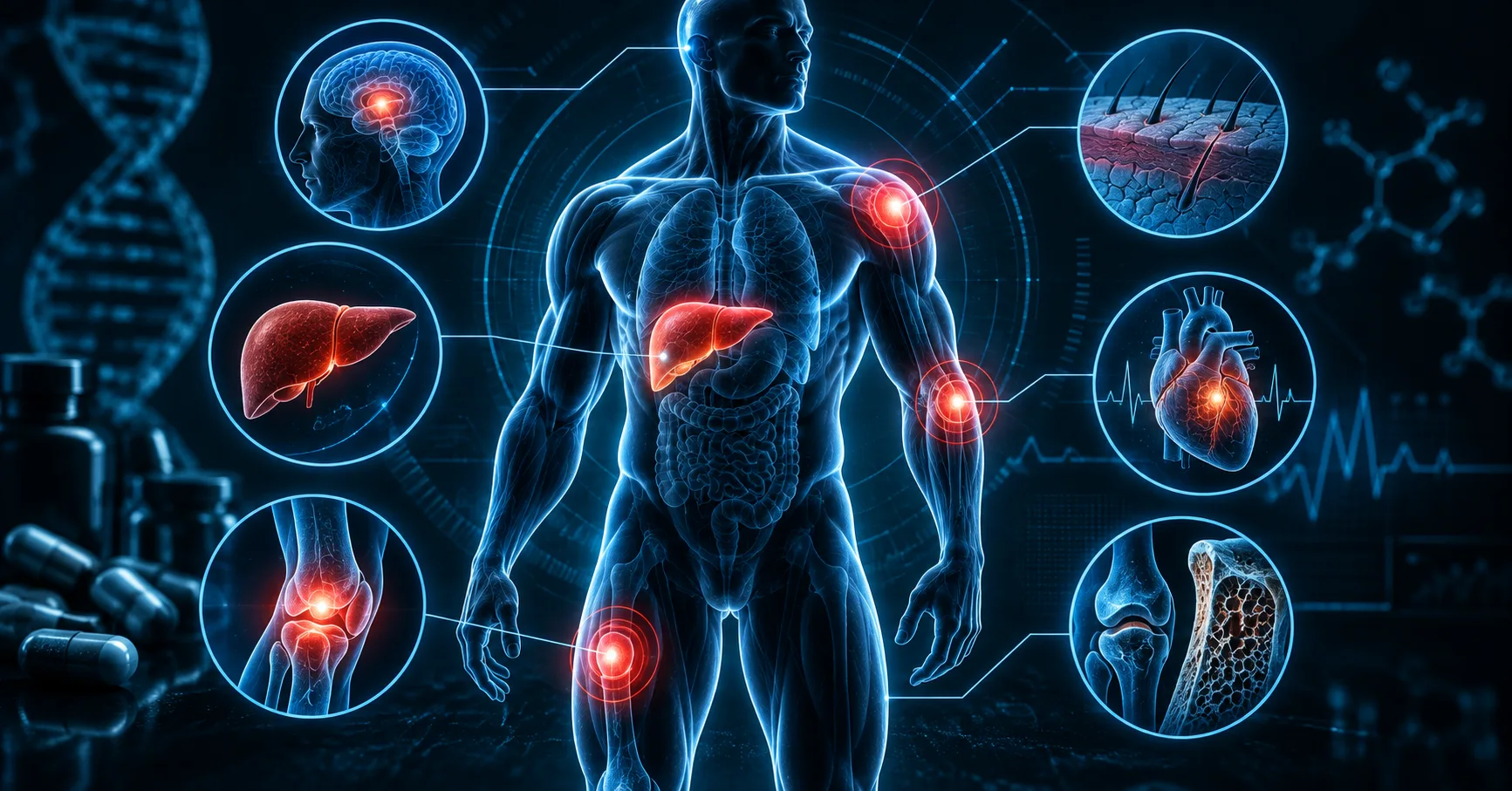
Across community logs and the limited clinical data in men, AI side effects on cycle cluster around six symptoms. Frequency and severity track the dose, the testosterone level being managed, body fat and genetics.
- 1Joint pain and stiffness: the most consistently reported. Estrogen maintains synovial fluid; when estradiol falls below roughly 15–20 pg/mL, knees, elbows and shoulders ache without a training cause and recover when estradiol does.
- 2Loss of libido: disorienting because it arrives on supraphysiological testosterone. Estrogen is central to the libido cascade in men independently of androgens; erection quality suffers with it.
- 3Low mood and flat affect: estradiol modulates serotonin and dopamine signalling. Men describe a dulling of motivation and emotional response rather than clinical depression, and it lifts as estradiol recovers.
- 4Fatigue: persistent tiredness that sleep does not fix, usually with reduced gym performance despite adequate training.
- 5Flat pumps and a deflated look: estrogen holds intracellular water; without it the full look that comes with high testosterone disappears whatever the diet.
- 6Brain fog: reduced focus and memory, reported less often but consistently.
The absence of these symptoms does not prove estradiol is in range, and the Aromasin dosage guide sets out why the week-five draw is scheduled whether or not a man feels anything.
What the Clinical Trials Report
The published data on aromatase inhibitors side effects come almost entirely from postmenopausal women on daily full-dose therapy for years, so the absolute rates overstate what a man sees on EOD dosing for 16 weeks. The direction of the findings, and the comparison between drugs, transfer directly.
Aromatase inhibitor side effects in clinical trials
Hot flashes
~35%
~21–33%
Prescribing labels
Arthralgia, joint pain
15–18%; up to 47% patient-reported
15–18%; slightly lower patient-reported
Labels, cohort surveys
Osteoporosis, bone loss
Higher
Lower
MA.27, 7,576 women
Hypercholesterolemia
Higher
Lower
MA.27
Hypertriglyceridemia
Higher
Lower
MA.27
Liver enzyme elevation
Rare
~2% raised bilirubin
Labels
Vaginal bleeding (women)
Higher
Lower
MA.27
Fracture rate
Similar
Similar
MA.27
The MA.27 trial randomised 7,576 women to exemestane or anastrozole and found identical cancer outcomes at 4.1 years but less osteoporosis, less hypercholesterolemia and less hypertriglyceridemia on exemestane. That pattern, with the joint pain reports, is why the Aromasin vs Arimidex comparison favours exemestane for anything long-term.
Joint Pain: The Side Effect Men Report Most
Aromatase inhibitor joint pain is the best documented AI side effect in both the breast cancer literature and bodybuilding logs. Patient-reported surveys in cancer populations put arthralgia at 40–47% on long-term therapy, far above the placebo arms of controlled trials. In men on cycle the mechanism is the same: estradiol maintains cartilage and synovial fluid, and below roughly 15–20 pg/mL joint surfaces lose lubrication and the friction hurts.
Anastrozole carries an extra consideration. Community reports and some preclinical work suggest it affects collagen synthesis through a route beyond aromatase inhibition, and men who switch from Arimidex to Aromasin at the same estradiol often report the joints improve. The mechanism is not proven, but the pattern is consistent enough across logs to act on. Exemestane's weak androgenic metabolite, 17-hydroexemestane, may supply a small amount of androgen signalling to connective tissue that anastrozole cannot, which is the leading explanation.
Managing it, in order:
- 1Draw a sensitive estradiol before assuming the drug is at fault; joint pain with crashed estradiol is a dose problem
- 2If estradiol is below 20 pg/mL, reduce the dose or lengthen the interval; nothing else works
- 3If estradiol is 20–40 pg/mL and joints still hurt on anastrozole, switch to exemestane after a two-to-three-day gap
- 4Fish oil, collagen and glucosamine are adjuncts at best; none replaces getting the estradiol right
Bone Density: The Long-Term Cost
Estrogen is the primary regulator of bone mineral density in men as well as women. Male osteoporosis with age is driven substantially by falling estradiol, not testosterone alone, and men with genetic aromatase deficiency have the bone density of postmenopausal women.
On a single 8–16 week cycle followed by recovery, the bone risk is small; suppression that short does not produce measurable change. On continuous blasts, long-term TRT with an AI attached, or several cycles a year over many years, it accumulates. MA.27B, the bone sub-study of the MA.27 trial, measured bone mineral density directly and found exemestane's steroidal structure blunted some of the loss seen on anastrozole but did not prevent it.
The protection is the dose. An estradiol of 25 pg/mL is bone-protective; 10 pg/mL is not. Men on extended protocols should run the minimum AI that holds estradiol in range, keep calcium and vitamin D adequate, train with weights, and skip the AI entirely in any phase where blood work does not require it.
Lipid Effects
Every aromatase inhibitor lowers HDL by removing estrogen's effect on hepatic lipid handling. It is not compound-specific, though MA.27 found anastrozole worse than exemestane for both cholesterol and triglycerides. In a man on supraphysiological testosterone, HDL is already suppressed by the testosterone itself and further by any 17-alpha-alkylated oral, so the AI stacks a third hit on a lipid profile that is already under strain.
- 1Run a lipid panel with every hormone draw on any cycle beyond eight weeks
- 2Never run more AI than blood work requires; excess suppression adds lipid cost without benefit
- 3Fish oil at 3–4 g of EPA and DHA daily is one of the few supplements with real evidence for HDL support; cardio does more
Over-Suppression vs Compound Effect
The commonest error with aromatase inhibitors side effects is adjusting the wrong variable. Crashed estradiol and a compound-specific effect both produce symptoms, but the fixes are opposite: one needs less drug, the other may need a different drug.
Telling a crash from a compound effect
Symptom pattern
Joints + libido + mood + fatigue together
Joints alone, or one symptom
Timing
After raising the dose or adding frequency
Unchanged by dose changes
Blood work
Estradiol below 15–20 pg/mL
Estradiol 20–40 pg/mL
Fix
Reduce, lengthen interval or stop
Switch anastrozole → exemestane
Only blood work separates the two reliably. Adjusting on symptoms alone sets up the familiar oscillation between overcorrection and undercorrection that wastes half a cycle. The how to lower estrogen in men guide covers the estradiol assay to order and the reference points.
Managing Aromatase Inhibitors Side Effects on Cycle
The primary tool is dose control calibrated to blood work. Secondary measures exist; none substitutes for getting estradiol into range.
Reduce first. If estradiol is below 20 pg/mL with symptoms, lower the dose or lengthen the interval before anything else: exemestane 12.5 mg EOD to every third day, anastrozole 0.5 mg EOD to 0.25 mg. Retest in three weeks.
Stop if crashed. Below 15 pg/mL, stop the AI. With exemestane, estradiol begins rising in three to five days and recovers over one to two weeks as new aromatase is made; with anastrozole, relief starts within one to two days as the reversible inhibition lifts. No recovery protocol is needed and adding compounds only confuses the picture. Restart, if blood work justifies it, at half the previous dose. The 500 mg test cycle protocol shows the sequence on the most common cycle.
Switch if the joints persist. Estradiol in range and joint pain still present on anastrozole is the one clear case for changing drug rather than dose; allow two to three days for anastrozole to clear before the first exemestane dose.
Unlike testosterone suppression, low-estrogen side effects are self-limiting. Once the AI clears or the dose comes down, aromatisation resumes and estradiol returns on its own.
Bodybuilding Context vs the Clinical Numbers
A caution on reading the trial data: it comes from women on 25 mg exemestane or 1 mg anastrozole daily for five years. A man on 12.5 mg exemestane every other day for 16 weeks has a fraction of the exposure, and the absolute rates in the table above overstate his risk for hot flashes, bone loss and lipid change. The mechanisms are identical, so the direction holds, and the comparison between the two drugs holds; the severity does not scale down to zero, but it scales down. The full clinical profile at that dose is in exemestane side effects.
What a man on cycle should actively manage: joint pain as a dose signal, libido and mood as estradiol trackers, a lipid panel on any protocol beyond eight weeks, and bone density only if the protocol runs for years. The Aromasin half-life guide explains why exemestane's slow offset makes an overshoot easier to catch than anastrozole's, and the bodybuilding hub sets the AI in the wider cycle plan.
Joint pain and stiffness, loss of libido, low mood and flat affect, fatigue, flat pumps and brain fog. Nearly all of them are signs of estradiol suppressed below roughly 15–20 pg/mL rather than drug toxicity. A sensitive estradiol result confirms it, and the fix is a lower dose, not another supplement.
Yes. With exemestane, estradiol begins rising three to five days after the last dose and recovers over one to two weeks as new aromatase is synthesised. With anastrozole, relief starts within one to two days as the reversible inhibition lifts. Bone density lost over years of use takes far longer to rebuild.
Confirm with blood work first. If estradiol is below 20 pg/mL, joint pain is a crash and resolves with a lower dose. If estradiol sits at 20–40 pg/mL and the joints still hurt on anastrozole, switching to exemestane at the same estrogen control is the most reliable fix. Supplements are adjuncts, not solutions.
They can. Estrogen is the main bone-protective hormone in men, and suppressing it for years measurably lowers bone density; the MA.27 trial found more osteoporosis on anastrozole than exemestane. A single 8–16 week cycle carries little risk. Running the minimum dose that keeps estradiol in range, with calcium, vitamin D and weight training, is the protection.
Exemestane, on the evidence. At the same estrogen suppression it produces less joint pain in community reports and, in the MA.27 trial, less osteoporosis, lower cholesterol and lower triglycerides than anastrozole. Symptoms that come purely from low estradiol, mood, libido and fatigue, are identical on either drug when estradiol is equally suppressed.
For men on cycle, mostly none: the side effects blamed on the drug are the symptoms of estradiol pushed too low. The exception is anastrozole-specific joint pain, which some evidence links to collagen effects independent of estrogen and which shows up with estradiol in range and none of the other low-estrogen symptoms.
Aromasin.org is an independent educational resource. We are not affiliated with Pfizer, any pharmaceutical manufacturer, or healthcare provider. This content is for informational purposes only and does not constitute medical advice.
Editorial
Author
Comments (0)
Be the first to comment on this article.