Aromasin Half Life: What It Means for Dosing and Timing
The Number on the Forums Is Wrong
Ask about Aromasin half life on any bodybuilding board and the answer comes back as 9 hours, followed by an argument about whether that means daily dosing. Both halves are off. The prescribing information for exemestane gives a mean terminal half-life of about 24 hours, with peak plasma levels 1.2 to 2.9 hours after a dose. The 9-hour figure appears to come from an early distribution phase in older pharmacokinetic work and has been copied from post to post for years.
More important than either number is that plasma half-life is the wrong measure for this drug. Exemestane is an irreversible aromatase inhibitor: each enzyme molecule it binds is permanently destroyed, and estrogen production only returns once the body has made new enzyme. The drug can leave the blood while its effect stays. Pfizer's own data show maximal estrogen suppression arriving two to three days after a dose and persisting for four to five days, with whole-body aromatisation reduced by about 98% at 25 mg.
That gap between a 24-hour half-life and a four-to-five-day effect is the whole story of Aromasin dosing, and this guide works through what it means for dosing interval, timing, stopping, PCT and how the numbers compare with Arimidex and letrozole.
Key takeaway: exemestane's half-life is about 24 hours, but its estrogen suppression lasts four to five days because the enzyme it destroys has to be rebuilt. Every-other-day dosing follows from the effect, not from the half-life.
Plasma Half-Life vs Functional Effect
Two things are usually conflated in Aromasin half life discussions: how long the molecule stays in the blood, and how long its effect lasts. For a reversible drug the two track each other closely; for exemestane they diverge by days.
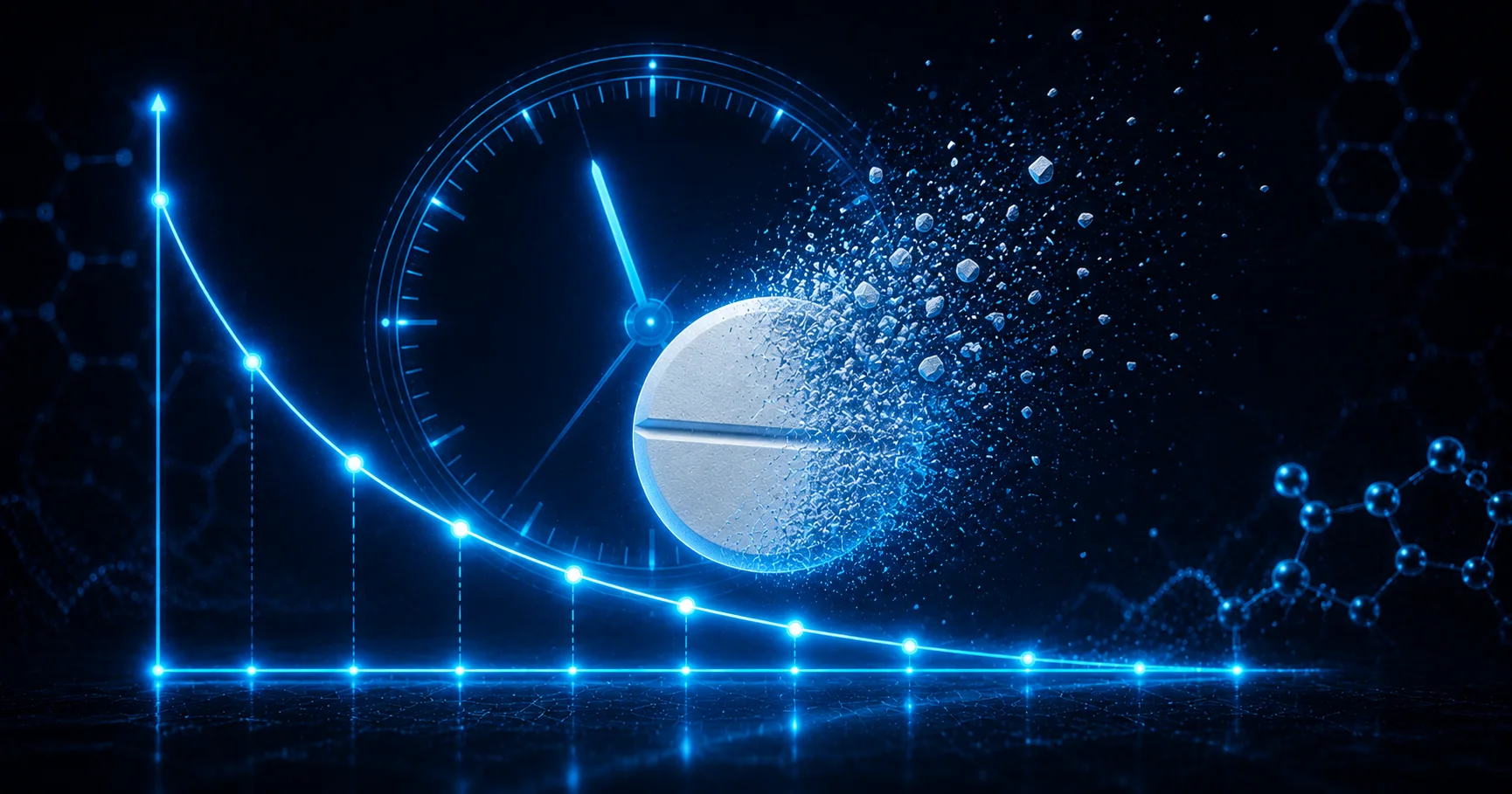
The plasma side is simple. After a 25 mg oral dose exemestane peaks within one to three hours, is 90% bound to plasma proteins, is metabolised mainly by CYP3A4, and declines with a terminal half-life of roughly 24 hours. Within two days the parent drug is largely gone. A high-fat meal raises exposure substantially, increasing AUC by 59% and peak level by 39%, which is why the label says to take it after food and why switching between fed and fasted dosing shifts the effective dose. The clinical reference for the drug is the exemestane guide.
The effect side is different. Exemestane is structurally similar to androstenedione, the enzyme's natural substrate. Aromatase processes it as if it were a hormone, and in doing so becomes permanently inactivated: a "suicide" substrate. No amount of drug clearance restores that enzyme. New aromatase has to be transcribed and built, and in adipose and other tissue that takes days. Circulating estrogen therefore bottoms out two to three days after a dose and stays suppressed for four to five, long after the plasma level would predict.
This is why exemestane can be dosed every other day, and why the Aromasin dosage guide never recommends daily dosing at cycle testosterone levels: the mechanism outlasts the molecule.
What the 24-Hour Half-Life Actually Tells You
The Aromasin half life figure of about 24 hours comes from pharmacokinetic studies in healthy volunteers and in postmenopausal women with breast cancer, the population the drug was developed for. It tells you how fast the parent drug clears, which matters for three practical questions.
First, drug interactions. Because exemestane is cleared by CYP3A4, inducers such as rifampin, carbamazepine and St John's wort shorten its residence and lower exposure; strong inhibitors do the reverse. Second, steady state. With a 24-hour half-life and every-other-day dosing, exemestane never accumulates the way a long-half-life drug does; each dose is close to a fresh one, and the cumulative effect comes from enzyme destruction rather than from rising blood levels. Third, detection. The parent drug is gone from plasma within about two days, but its metabolites, including the androgenic 17-hydroexemestane, are detectable in urine for considerably longer, which matters for tested athletes since exemestane is WADA-prohibited.
Compare anastrozole. Its plasma half-life is roughly 50 hours and it reaches steady state after about a week of daily dosing. Anastrozole binds aromatase reversibly, so its suppression depends on the drug being present; the long half-life is what makes once-daily or EOD dosing work. Exemestane does not need continuous presence, and that is why its short half-life is not a disadvantage. The Aromasin vs Arimidex comparison sets the two mechanisms side by side.
How Long for Aromasin to Work
Measured by blood estradiol, and despite the Aromasin half life debate, exemestane works faster than its dosing interval suggests. In clinical pharmacology studies, suppression of circulating estrogen begins within hours of the first 25 mg dose and reaches its maximum at two to three days, with plasma estradiol, estrone and estrone sulfate down by 85–95%. At the 12.5 mg EOD dose used on a cycle the ceiling is lower and the timeline similar: estradiol falls meaningfully within the first 48 hours and settles into its new range over the first week, which is why the first blood draw is scheduled at week four or five rather than earlier.
Symptoms lag the numbers. Water retention from high estradiol takes several days to resolve once estrogen falls, and nipple sensitivity a week or more. A man who starts Aromasin because of bloat and sees no change in 48 hours is not looking at a failed drug; he is looking at a normal delay. Conversely, symptoms of a crash, dry joints and a flat libido, take three to five days to appear after the dose that caused them, because the enzyme population declines dose by dose. The 500 mg test cycle protocol shows the expected timeline on the most common cycle.
Aromasin timeline after a 25 mg dose
1–3 hours
Peak
Beginning
24 hours
About half of peak
Substantial
2–3 days
Largely cleared
Maximal, 85–95%
4–5 days
Gone
Still suppressed
7–14 days
Gone
Recovering as new enzyme forms
What Aromasin Half Life Means for Dosing Frequency
The dosing framework that follows from the pharmacology is about enzyme turnover, not drug clearance.
- 1Every other day: the standard cycle interval. Matches the rate at which new aromatase appears well enough to hold estradiol steady at 400–600 mg of testosterone per week on 12.5 mg, or higher doses on 25 mg.
- 2Every third day: for men who overshoot on EOD, on lower testosterone doses, or tapering at cycle end and into PCT.
- 3Twice weekly: the TRT interval at 100–200 mg of testosterone, where aromatisation is modest and EOD dosing crashes most men.
- 4Daily: wrong at cycle doses. The 24-hour half-life makes it feel safe because the drug clears, but enzyme destruction accumulates faster than the body rebuilds it, and estradiol drifts down until it crashes, usually inside two to three weeks.
- 5Once weekly: too little on cycle. Suppression fades after four to five days and estradiol climbs for two days before the next dose, producing a sawtooth rather than a steady level.
Time of day does not matter. Consistency with food does, because a meal raises exposure by more than half; take it the same way every time.
How Long Does Aromasin Stay in Your System
The question has two answers, and both follow from the Aromasin half life numbers above.
Drug clearance: with a 24-hour terminal half-life, the parent compound is essentially gone from plasma within about 48 hours of the last dose at cycle doses. Metabolites persist in urine for longer, which is the figure that matters for a drug test.
Effect duration after stopping: estradiol does not rebound the moment the drug clears. It recovers at the pace of aromatase synthesis. Most men see estradiol begin to rise three to five days after the last dose, and a full return to the level their testosterone dose and body fat would produce without an AI takes roughly one to two weeks. That gradual climb is what makes exemestane forgiving: if blood work shows a crash, stopping the drug brings relief within days but does not produce an estrogen spike, and there is no rebound of the kind anastrozole can cause when its reversible inhibition lifts overnight.
For a man who has crashed his estradiol, the protocol is patience. Stop the AI, wait five to seven days, restart at half the previous dose if blood work justifies any AI at all. Adding compounds to "bring estrogen back" introduces variables and rarely helps.
Half-Life at the PCT Transition
The Aromasin half life shapes two decisions at the end of a cycle.
Switching from Arimidex before PCT: anastrozole's 50-hour half-life and reversible binding mean it needs two to three days to clear before the first exemestane dose; running both together stacks suppression. After the gap, exemestane establishes its own suppression within two to three days.
Stopping Aromasin during PCT: in the standard protocol exemestane runs at 12.5 mg EOD for the first two to three weeks alongside the SERM, then tapers to every third day and stops. Because suppression fades over four to seven days as new enzyme appears, there is no cliff. Estradiol rises gently as natural testosterone recovers under tamoxifen or clomiphene, which is the behaviour a PCT needs. The Aromasin bodybuilding guide covers the full PCT sequence, and the cycle hub sets the AI phase in the wider cycle plan.
Aromasin vs Arimidex vs Letrozole: Half-Lives Compared
Half-life and effect duration of the three aromatase inhibitors
Aromasin (exemestane)
~24 hours
Irreversible, steroidal
4–7 days, gradual
Arimidex (anastrozole)
~50 hours
Reversible, non-steroidal
1–2 days, can rebound
Letrozole (Femara)
~2–4 days
Reversible, non-steroidal
3–5 days
The Aromasin half life comparison shows why a short half-life is not a weakness. Anastrozole and letrozole need long plasma half-lives because their suppression exists only while the drug is bound; the longer they linger, the smoother the effect. Exemestane's suppression exists in the destroyed enzyme, so it can clear quickly and still hold estradiol down for days. The combination of a 24-hour half-life and a four-to-five-day effect is exactly what makes every-other-day dosing both adequate and safe, and what makes the drug the preferred aromatase inhibitor for men who need one on TRT or in PCT.
The prescribing information gives a mean terminal half-life of about 24 hours, with peak plasma levels one to three hours after a dose. The 9-hour figure quoted on forums is outdated. Because exemestane destroys the aromatase enzyme rather than blocking it, estrogen suppression lasts four to five days, far beyond the half-life.
The dosing interval follows the rate at which the body rebuilds aromatase, not drug clearance. Each dose permanently deactivates a share of the enzyme, and new enzyme takes days to appear, so every-other-day dosing holds estradiol steady. Daily dosing destroys enzyme faster than it is replaced and crashes estrogen.
The parent drug is gone from plasma within about 48 hours, though metabolites remain detectable in urine for longer. The effect outlasts the drug: estradiol begins rising three to five days after the last dose and returns to its un-suppressed level over one to two weeks as new aromatase is made.
Estrogen suppression begins within hours of the first dose and reaches its maximum, an 85–95% fall in circulating estrogens at 25 mg, after two to three days. Symptoms lag the blood work: bloat takes several days to resolve and nipple sensitivity a week or more, which is why the first blood draw is at week four or five.
Exemestane's plasma half-life is about 24 hours against roughly 50 hours for anastrozole, but the functional picture reverses. Anastrozole needs its long half-life because its inhibition is reversible; exemestane's irreversible enzyme destruction keeps estrogen suppressed for four to five days after the drug has cleared. Both are dosed every other day for different reasons.
No. Rebound is a feature of reversible inhibitors like anastrozole, where lifting the drug releases the enzyme overnight. With exemestane the enzyme is gone and has to be rebuilt, so estradiol climbs gradually over one to two weeks. That gentle recovery is why Aromasin is preferred at the PCT transition.
Aromasin.org is an independent educational resource. We are not affiliated with Pfizer, any pharmaceutical manufacturer, or healthcare provider. This content is for informational purposes only and does not constitute medical advice.
Editorial
Author
Comments (0)
Be the first to comment on this article.